By Sam Wilson
Every day, new headlines warn that A.I. is replacing entry-level roles. Data entry, routine design tasks, basic analysis, and entry-level programming have all seen massive drops in openings and new hires.
For decades, these were the on-ramps into professional careers. They were the jobs Millennials, Gen X, and yes, Boomers, used to learn, build experience, and work their way up.
For Gen Z and the generation coming behind them, that on-ramp is shrinking fast. The concern is real, and it’s understandable. When traditional entry-level roles disappear, it can feel like the entire career ladder is being pulled up behind the people who already climbed it.
But this isn’t the first time technology has disrupted the workforce, and history gives us an important reminder.
When One Door Closes, Another Opens
When cars replaced horses, entire industries disappeared: stable hands, blacksmiths focused on horseshoes, carriage manufacturers, manure collectors.
But new careers emerged. Auto mechanics, automotive engineers, gas station attendants, highway construction, logistics and trucking, automotive insurance.
Technology didn’t eliminate work, it shifted it. And many of the new roles that emerged became stable, essential careers that lasted for generations. I believe we’re seeing the same kind of shift today.
AI is absolutely changing how work gets done. Some jobs are being automated. Some are being reduced. Some are being fundamentally redefined.
But at the same time, entirely new career paths are opening, especially where software meets the physical world.
One of the biggest and most overlooked of those fields is building automation systems (BAS).
Building Automation: Where AI Meets the Real World
AI doesn’t exist in a vacuum.
For artificial intelligence to do anything meaningful in the physical world, it needs systems to connect too that can sense, control, and optimize real equipment. That’s exactly what building automation systems do.
BAS controls and monitors:
- HVAC systems
- Lighting
- Energy usage
- Indoor air quality
- Security and access control
- Lab environments and hospital systems
- Data center cooling and redundancy systems
From smart campuses and high-performance hospitals to data centers and advanced manufacturing facilities, BAS is the digital nervous system of modern buildings.
When people talk about “smart buildings,” what they’re really talking about is building automation. And as AI becomes more integrated into how buildings operate, like optimizing energy use, predicting failures, improving comfort, and managing complex facilities, those systems become even more critical, not less.
This is one of the rare fields where AI doesn’t replace people, it creates more demand for skilled professionals who can design, install, program, integrate, and maintain these systems.
Why Building Automation Is a Strong Career Path
Building automation sits at the intersection of several powerful trends:
- Return to office trend for large companies and government agencies
- Aging workforce – the average age of facility managers is 50 years old
- Energy efficiency and sustainability mandates
- Electrification and decarbonization
- Smart infrastructure and IoT
- AI-driven analytics and optimization
- Aging building systems that must be upgraded
These aren’t short-term trends. They’re long-term structural shifts in how buildings are designed and operated. That means demand for BAS professionals continues to grow, and it’s growing fast.
What makes this field especially attractive is that it’s not purely software and it’s not purely mechanical, it’s both.
A career in building automation means:
- Working on cutting-edge technology that directly impacts sustainability and energy use
- Blending hands-on field work with advanced software and controls programming
- Seeing the real-world impact of your work every day (you’ll know right away if you missed a block in your sequence of operations!)
- Building highly transferable skills across healthcare, education, commercial real estate, and industrial sectors
- Long-term job security in a field that can’t easily be offshored or fully automated
And the reason is:
- Someone still has to understand how the building actually works
- Someone still has to review the plans and specifications and cover all owner requirements, while estimating all labor and materials needed to complete the job
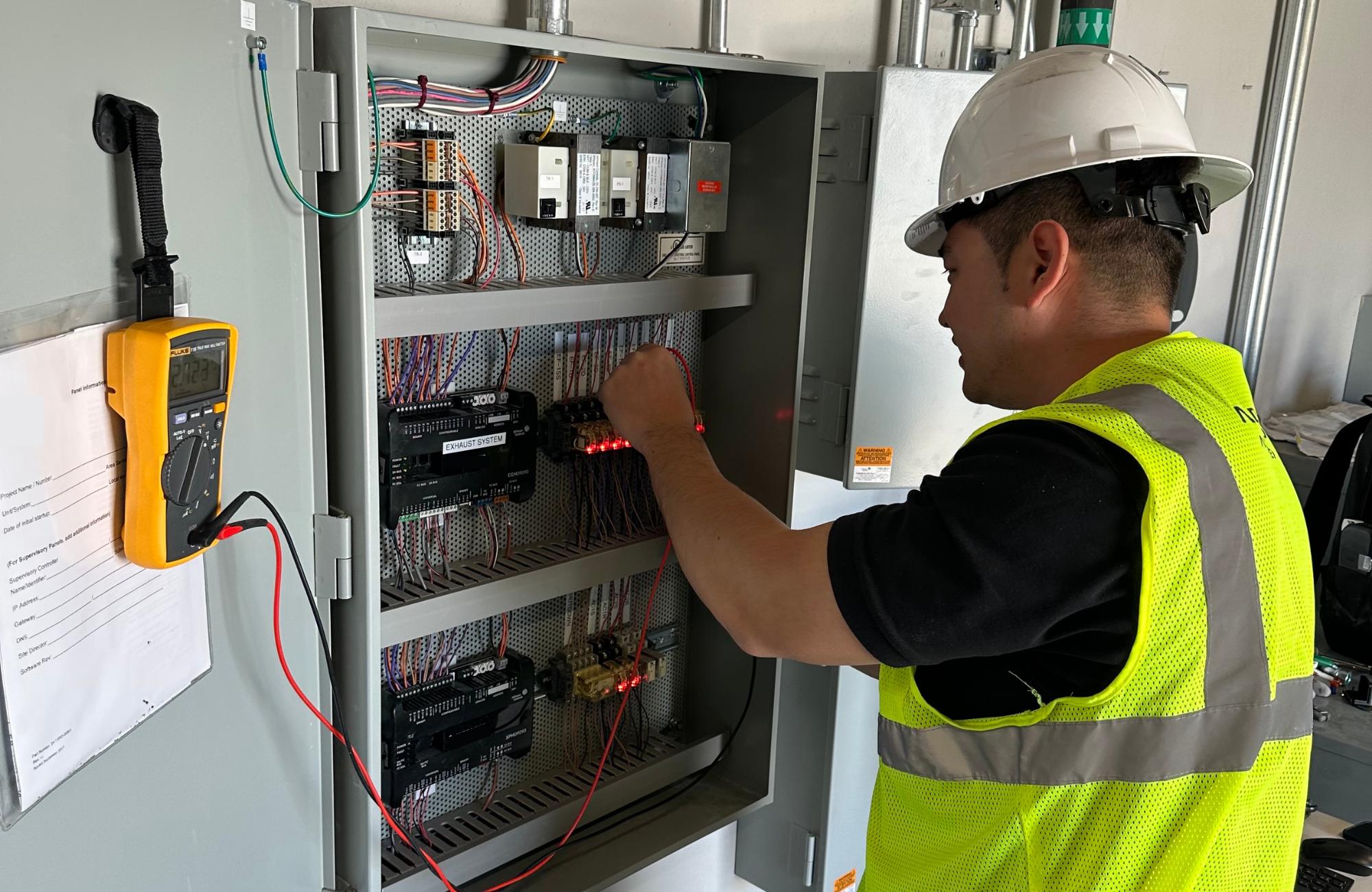
- Someone still has to physically install hardware, sensors, controllers, and program the software to make it all work
- Someone still has to commission, troubleshoot, and optimize these systems on site
And that human expertise becomes even more valuable as systems get more complex.
A New Kind of “Entry Level”
One of the biggest misconceptions about building automation is that it requires decades of experience before you can contribute. Getting your foot in the door does take some education and experience. Outside of engineering jobs, most of the entry level jobs require training equivalent to a two-year community college degree, and some real-world experience, like an internship.
In reality, many BAS careers start with roles that blend training and real project work from day one:
- Controls technicians
- BAS design engineers
- Commissioning technicians
- Junior programmers
- Systems specialists
These roles provide exactly what traditional entry-level jobs used to offer:
- Exposure to real projects
- Mentorship from experienced professionals
- A clear path to skills specialization and career advancement
But instead of starting in jobs that may soon be automated, you’re starting in roles that are becoming more critical every year.
From there, career paths can branch in many directions:
- Senior engineering
- Project management
- Energy analytics
- Cybersecurity for building systems
- Sales engineering and consulting
- Product development
It’s not a single ladder, it’s a network of career paths.
Looking for a Different Kind of Opportunity?
For students, career-changers, and anyone feeling uncertain about traditional career paths, building automation offers something rare right now:
- A field that is growing
- A skill set that is hard to automate
- Work that blends technology and real-world impact
- And long-term demand across nearly every industry
At Albireo Energy, we see this shift happening every day. Our teams work on complex, high-performance buildings that rely on advanced automation to operate efficiently, safely, and sustainably.
We’re not just maintaining systems, we’re helping shape how the next generation of buildings will function.
Are you looking to find a new career track? Visit the Albireo Energy careers page to see the possibilities.