Albireo Energy PLUGGED IN is a news channel for our energy analysis and procurement customers, providing a monthly view into energy markets. We highlight key trends, pricing dynamics, and procurement insights to help you stay informed and make smarter energy decisions.

PJM Revises Backstop Procurement
In July 2026, PJM fell short of its capacity goal for the 2028/2029 Base Residual Auction (BRA) by 6,800 MW. Since that time, PJM and the FERC have been working to hold a Reliability Backstop Procurement. The initial plan was to hold the procurement during the first three weeks of October 2026. There are a number of goals for this procurement. Beyond the need to fill the gap of new generation, FERC directed PJM to design the procurement to assign costs to large load users which are primarily new data centers and away from current rate payers, especially residential users.
The FERC had several objections to the PJM plan and on September 29th issued a ruling delaying the procurement until PJM could address the concerns. PJM made an amended proposal in late October that was designed to address the FERC concerns. The new proposal calls for the procurement bid window to open March 1, 2027, and close on March 28th. The results will be posted on May 10th. The exact amount of the procurement is being adjusted. More current forecasts could reduce the gap from the initial 6,800 MW to as little as 630 MW as a few utilities have made downward adjustments to their initial forecasts. The cap of $555/MW-day remains unchanged, which is higher than the 2028/2029 BRA of $325/MW-day.
New Distributed Energy Resource Programs Come Online
In response to FERC Order 2222 to remove barriers to Distribution Energy Resource Aggregators (DERA), new Distributed Energy Resource (DER) programs announced on both coasts could have a significant impact for providing grid reliability. ISO New England (ISONE) and California ISO (CAISO) both recently announced new incentive programs. First, California passed law SB 913. SB 913 has a deadline of June 2028 to provide guidelines for a number of provisions, but many are hoping for rules much earlier. Read SB 913 HERE.
Resources will be eligible for local, system, or capacity markets. They will receive credits for load reductions, including resource adequacy hours, and for direct energy contribution. Since companies can separately register multiple resources behind a single meter, they can join multiple aggregations. Aggregators are allowed to mix sources and technologies. The only stipulation is that companies do not receive duplicate compensation for the same performance event.
On the other side of the country, ISONE added more detail to their DER program. The ISONE program provides for seven different participation models which include: Dispatchable DERA (DDERA), Binary Storage Facility (BSF), Continuous Storage Facility (CSF), Demand Response Resource (DRR), Demand Response Distributed Energy Resource Aggregation (DRDERA), Alternative Technology Regulation Resource (ATRR) and Settlement Only Distributed Energy Resource Aggregations (SODERAs). Resources may participate in the real-time or day-ahead energy markets or ancillary markets as well as the capacity market.
Read the information on the ISONE website HERE.

Market Update
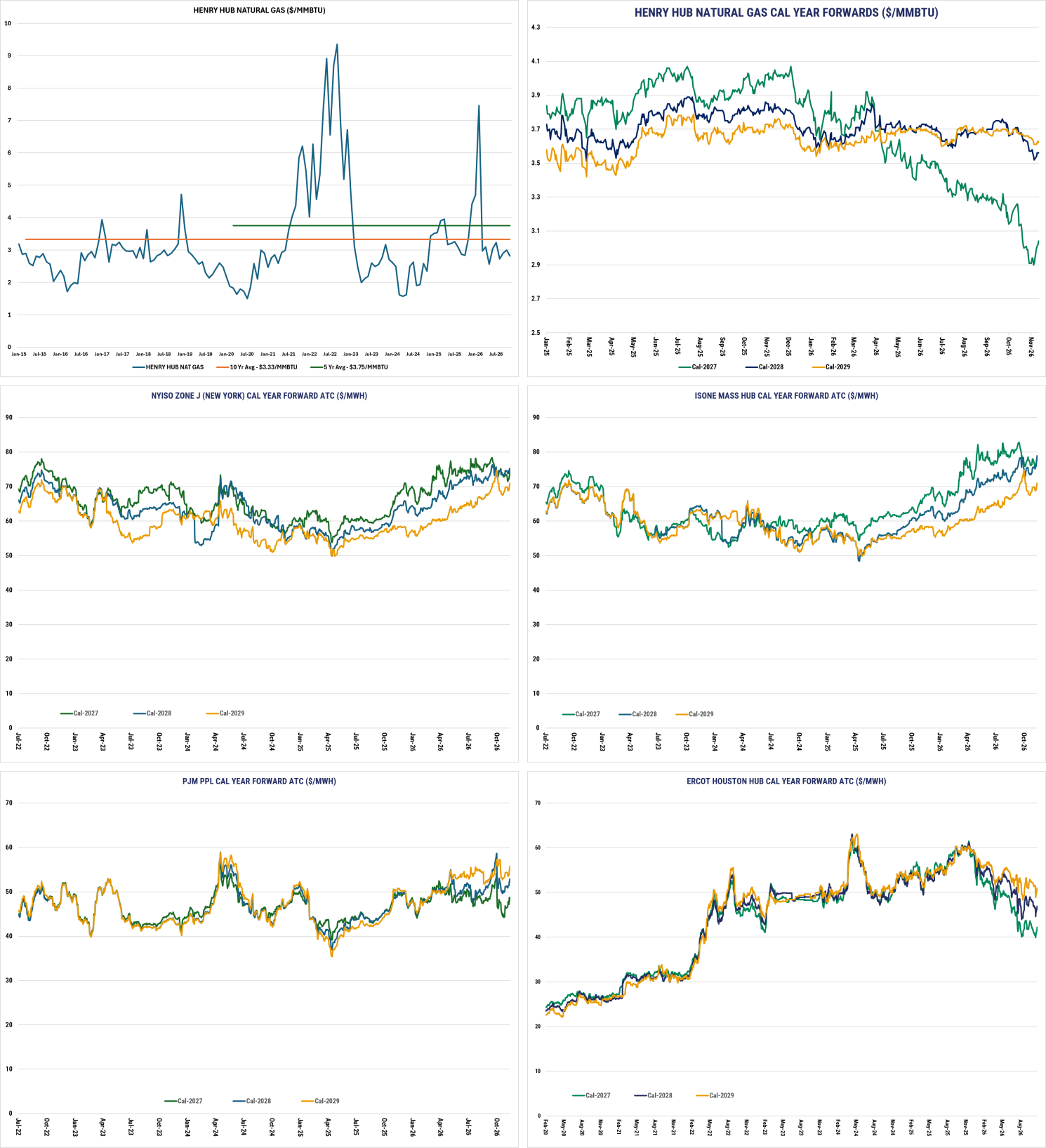
The 2027 Natural Gas strip bounced off of what may become the floor in recent days, but pricing in 2027 remains very attractive. Cal 2028 and 2029 are 15% and 20% higher respectively. Electricity prices finally appear to have leveled off in all markets. Markets in the northeast, especially New England continue to be backwardated with 2029 trading over a cent ($/kWh) cheaper than 2027.

Contact Customer Service at email: [email protected], phone: 855.521.8780, or through our online portal.
Reminder, it is budget season and with winter pricing looming it is important for early review of budgets for 2027. Please reach out to your contact or customer service at [email protected] to start an early review of energy purchasing budgets for 2027.