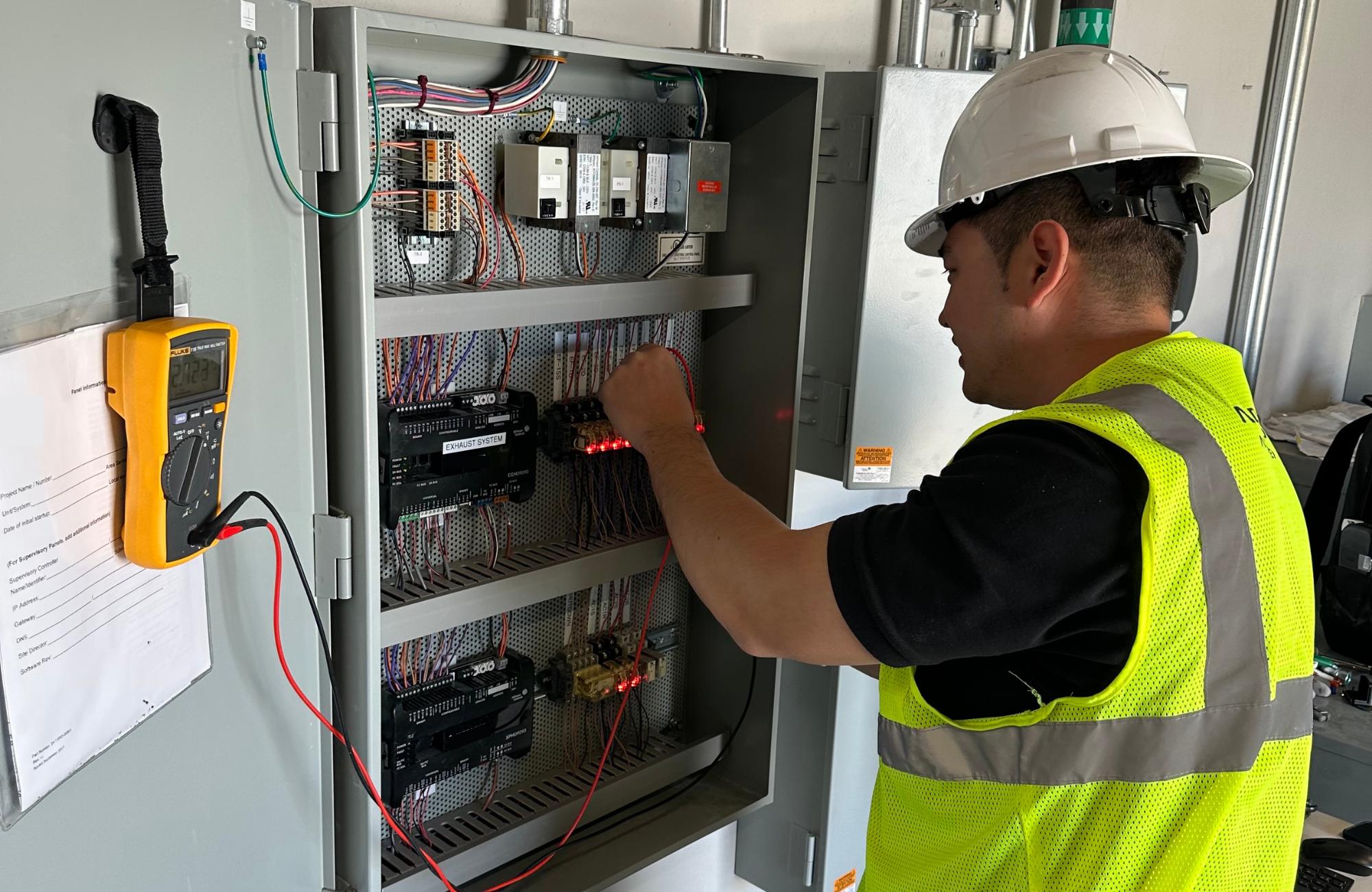
Gone are the days when commercial buildings’ Operational Technology (OT) lived independently from Information Technology (IT), each siloed and managed in their own domains. In today’s commercial building landscape, building systems like HVAC, lighting, controls, sensors, and energy management are increasingly automated, intelligent, and interconnected. Which also means they’re increasingly intertwined with IT networks.
This mingling of IT and OT presents an array of challenges, for both IT teams and facilities departments, including competition for limited resources, increased management burden for IT teams, and greater exposure to cybersecurity risks. With the proliferation of automated building systems, IoT sensors, and connected devices, IT departments are having to direct more resources to managing OT. Studies show that IT teams spend around 30-40% of their time maintaining infrastructure and routine operations, with building systems and OT devices being an increasingly large part of their workload.
Managing OT with Shrinking Budgets
While IT and facilities departments share many of the challenges of comingled OT and IT, they typically don’t share the costs. Currently, the cost of managing and upkeeping OT systems generally falls on facilities. Even as the complexity of automated building systems has increased, facilities budgets have gone in the other direction — decreasing
xsubstantially over the past decade as facilities departments become leaner. In fact, in a 2025 report, 84% of facilities management leaders cited budget constraints and escalating operational costs as their primary concern. Around 75% of facilities teams say that budget restrictions are limiting modernization efforts.
Meanwhile, IT budgets have expanded as technology becomes central to almost every business function, and investments in cloud services, cybersecurity, subscription-based software, data analytics, and AI soar — in the process, placing more demand on IT infrastructure and IT staff. According to a Gartner CFO survey, 46% of respondents said they plan to increase investments in digital technology over the next two years, while 66% intend to maintain or decrease facilities budgets.
For many commercial buildings, the line between facility operations and IT has blurred. OT has become enmeshed with IT. The responsibility for funding OT improvements and investments, however, remains largely in the hands of facilities departments operating with shrinking budgets.
Why OT Is an IT Issue
Historically, IT departments have not shared the cost of making and managing OT investments. This remains largely true today, even as many of these systems now run on the IT network and fall under IT purview. The reality is: IT departments now own much of the underlying infrastructure — network, cybersecurity, monitoring, and data performance — that OT systems rely on to function safely and efficiently.
There’s a strong case to be made for IT assuming some of the budgetary burden for OT systems. Modern, automated building systems often run on the same IP networks as IT, which means that cybersecurity, uptime, and data integration now span both IT and facilities domains. When IT chips in part of their budget for OT management and investments, commercial building stakeholders can better align IT spends with facility performance goals and capture greater savings in energy usage, maintenance-related costs, and staffing.
So how do we make OT budget-sharing more palatable to IT departments? One clear solution is by moving OT to a private cloud environment.
The IT Advantages Cloud-Based OT
Moving OT to a secure private cloud environment addresses many of the challenges around intertwined OT and IT. Decoupling OT from the IT network makes it easier for facilities teams to access the systems, applications, and data they need to ensure building performance, while relieving IT teams of the responsibilities of monitoring and managing OT systems and shoring up cybersecurity gaps. Read more about the advantages of a private cloud solution for OT here.
So why should IT share some of the cost for hosting OT in the cloud? In presenting the case for cost-sharing, we can point to a range of advantages that make the investment worthwhile for IT departments and their leaders.
Reduced Total Cost of Ownership
Moving OT systems to a private cloud environment can save costs by reducing IT departmental scope. Often without being consulted, IT are expected to inherit the maintenance responsibilities of OT server PCs procured during large construction or capital expense projects.
These on-premises servers are specified by third-party design engineers as part of boiler plate specifications, which IT departments typically don’t review or approve yet are still expected to maintain. Removing the burden of these servers from the IT’s area of responsibility creates cost avoidance around their inherited or assumed assets that may or may not conform to departments policies and standards.
Cloud-based OT helps conserve facilities-related costs as well. With faster, more streamlined access to OT systems and data, facilities departments can more easily and proactively conduct preventative maintenance, improve the occupant experience, and capture opportunities for increased energy efficiencies — all of which reduce costs and improve the profitable performance of the building.
Maximizing IT Resources
IT departments often bear the brunt of managing OT workloads on local networks, including backups, security patches, updates, and scalability. By moving OT to a cloud environment, IT can offload these burdens to a third-party provider. This reduces the need for hardware upkeep, including patching, backups, vulnerability management, and monitoring.
With OT systems now managed in the cloud, IT teams no longer have to juggle disparate building systems from different manufacturers and vintages. Relieving IT of these burdens
frees precious resources for core functions while enabling facilities departments to do their jobs more efficiently and productively.
Enhanced Cybersecurity
OT has increasingly opened the door for cyberthreats, exposing IT networks to vulnerabilities and risks. Moving OT to a secure private cloud environment isolates those systems from IT networks, boosting cybersecurity with centralized visibility and automated updates. Which means the IT team no longer has to spend time and resources installing firewalls, scanning for viruses, and preventing malicious intruders from moving laterally into sensitive business servers through OT systems.
In a secure purpose-built OT cloud environment, OT systems are specifically monitored for threat detection and have manufacturer-coordinated vulnerability management without the need for IT to develop expertise on their facilities department’s preferred OT products. Cloud solutions also come with built-in automation for security patches and firmware updates without disrupting operations.
Leading cloud platforms include advanced security features, like Zero Trust architecture and AI-driven incident response, to ensure resilience. Features like one-click recovery and backup/disaster recovery keep downtime to a minimum. What’s more, all these security responsibilities are offloaded to a third-party expert so that IT no longer has to deal with them.
Simplified Scalability
Moving IT to the cloud represents a shift from rigid, hardware-bound on-premise systems to elastic, on-demand infrastructure. With the ability to handle vast amounts of data from HVAC, sensors, and automated controls across locations, the cloud supports seamless scalability for multi-site portfolios. This also allows for real-time analytics and AI integration, which IT can leverage to make faster, smarter decisions.
Cloud platforms additionally enable on-demand scaling, automatically provisioning resources like compute power, storage, and bandwidth to match any increase in system demands such as adding more buildings or square footage to an OT control system. This also sets up the possibility for real estate management companies to standardize and create single pane of glass systems with a consistently high-availability user experience for their teams.
Again, this frees IT staff from being part of these expansion projects, improving delivery time for OT providers as well as warranty and service response time. This also allows owners to provide access to third parties such as commissioning agents or analytics providers without IT involvement.
Access to Data
With a unified view of system data and shared dashboards, IT and facilities teams can work together to use these OT systems to provide the information they both need for smooth business operations. Where facilities departments are concerned about mission critical equipment conditioning building environments, IT can use these same systems for critical alarming and dashboarding of server room temperatures and equipment, allowing both parties to collaborate on their respective areas of responsibility.
When OT and IT are decoupled, roles become clearer with less overlap and room for disputes. IT sticks to what they do best: making sure the business network stays up and running, efficiently and securely. And facilities have the access, visibility, and autonomy they need to keep the building and its systems operating efficiently, comfortably, and safely without disruption.
Outside Expertise Frees IT Resources
One of the most compelling advantages of moving OT to a private cloud environment — and another reason for IT to share the cost — is the ability to offload IT responsibilities and risks to a third-party cloud expert.
Albireo Energy’s Private Cloud Services (PCS) comes with this expert support. Along with a secure, scalable, and reliable dedicated private cloud environment, our team provides IT and facilities departments access to specialized cloud and OT expertise, 24/7 remote monitoring, and managed infrastructure. This saves IT and facilities departments the time and cost of hiring, training, or staffing-up for OT and/or cloud-specific competencies.
Albireo Energy’s PCS also provides centralized visibility, security, and patching to simplify Zero Trust compliance and reduce the overhead of running on-premise OT services, backups, and routine maintenance. By turning OT-cloud operations into a predictable subscription model, IT can avoid Capex spikes and enjoy more stable operating costs while freeing internal resource to focus on core technology projects. For IT and facilities departments, it’s a win-win.
Learn more about Albireo Energy’s Private Cloud Services and how cloud-based OT benefits IT and facilities departments alike. Reach out to us today.