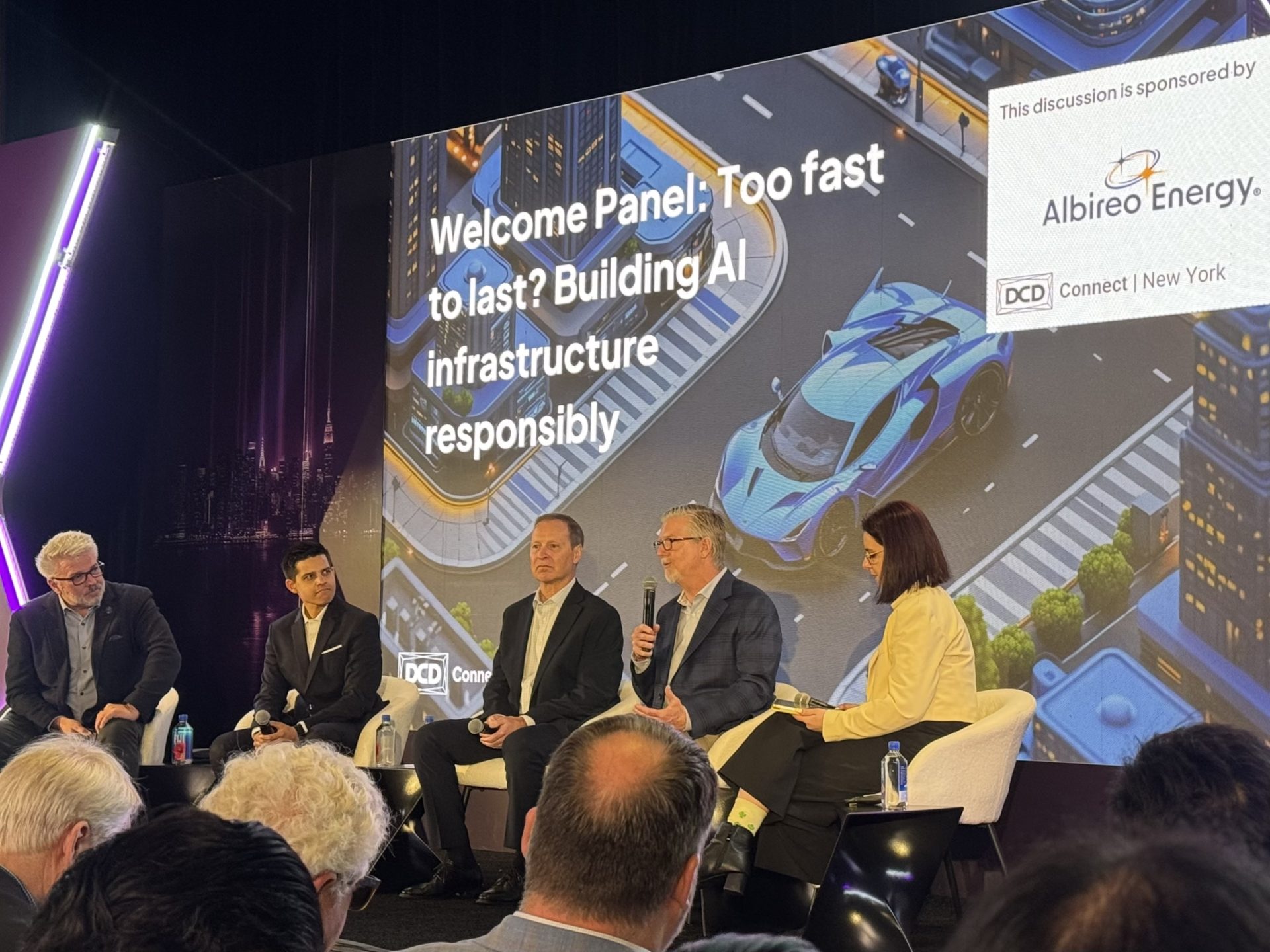
To kick off DCD>Connect | New York 2026, Albireo Energy sponsored the welcome panel discussion on the topic of “Too fast to last? Building AI infrastructure responsibly.”
The panel gathered experts in different aspects of a data center build out, including financiers, builders, owners, and energy management and control. These experts weighed in on the future of the industry and also identified the major issues facing the fast growth of the data center industry.
Albireo Energy’s Mike Revock, Solutions Architect, Mission Critical, was on the panel. It was moderated by Kat Sullivan, who is Head Of Channels Compute for Data Center Dynamics and SDxCentral.
Bridging the Workforce and Skills Gap
The lack of a trained workforce was a recurring theme. As the industry scales, the pool of trained professionals isn’t keeping pace, especially with a significant portion of senior experts nearing retirement.
Panelist Brian Hearst, Data Center & Life Sciences Builders Risk Leader at Aon’s Construction and Infrastructure Practice, said: “One statistic I’ve heard is that regarding electrical trade superintendents in the U.S., two in five will be retiring in the next couple of years with no replacement. These are the people that have the experience to train the young people.”
Mike Revock (Albireo Energy) added: “The big challenge is that we still need a busload of technicians on the job sites. As these sites press further away from major urban areas, how do we get all the skills out there? That’s a challenge we’re trying to bridge.”
One solution is to hire workers straight out of high school who are not on a path to college. Several of the panelists discussed programs to educate high school students on the possibilities of working to build and operate data centers.
But even with enough workers, there’s a logistics challenge. These workers need to eat and sleep and the massive numbers during a build out can overwhelm local hospitality facilities. Some companies are turning to Airbnb and third-party housing to house the staff needed onsite to commission the wiring.
Data Center Permitting
Data center permitting is becoming a significant bottleneck. There is an effort to simplify permitting for data centers on federal land, but for data centers going into non-federal land then each municipality has its own process, rules – and citizen feedback. Panelist Phill Lawson-Shanks, Chief Innovation Officer, Aligned Data Centers, said: “We don’t have so much an issue with the mechanics of permitting; it’s the community aspect. There’s a lot of “FUD” [Fear, Uncertainty, Doubt] out there about how much water we use—we don’t use water. Or how much power we take—we’re actually bringing power by building new substations. It’s a communication task.”
This makes it important to communicate the benefits of the data center to the local community and to be transparent. This takes a coordinated communications outreach to ensure that people know the real impact and benefits to their community.
Power Management
For the data center builder to bring those substations to a data center, there needs to be energy generation capability near the data center. The power requirements of the servers being deployed at AI data centers are growing with every generation of AI processor. Some server configurations can consume 2MW. To help manage power conversion loss, some data centers are using DC power instead of converting it into AC. At 800 volts, a DC power accident would be very deadly.
Power management is a critical response allowing a data center to get more out of every kilowatt. This is where advanced monitoring, time-series data and analytics become essential. Mike Revock said: “Most people operate with real-time data, but analytics looks at performance over time. It’s essential to minimizing PUE [Power Usage Effectiveness] and avoiding “PUE drift.”
Another aspect of the solution is bringing new sources of energy online such as small modular reactors (SMRs) that can bring a measure of energy self-sufficiency to a data center site.
Building Long Lasting Data Centers
The technology needed for AI is in a state of constant change and evolution, which brings a concern that today’s data center will face obsolescence.
Panelist Kushal Dagli, Global Data Center Deliver Optimization Lead, Microsoft, said: “I look at this ‘too fast to last’ from my lens as: how can we be nimble in this ever-changing environment? …So, I think the form factors are changing, design is evolving, and we’re going to get new chip development every other month …so, how can we be adaptable and create an interoperable system? That’s how I see the ‘too fast to last’ challenge. Are you building for two years, three years, or are you building for 20 years? That’s one of the biggest problems from a hyperscale perspective: is our infrastructure going to last the constant change that we’re about to see?”
One solution discussed by the panel is to embrace modularity by setting up servers and power equipment in skids that are pre-installed and wired, and can be delivered to a building, connected and be ready to go. And when an upgrade is needed that skid is pulled out and a new one installed.
Mike Revock highlights the advantages of skids: “Items like skidding and modularity are very helpful. A lot more gets done on the factory floor, which minimizes the “compression” that happens at the end of a job.”
One of the challenges to this is skid dimensions: they are the size of shipping containers, weigh as much as an elephant and can be moved only with a robotic tug. When building a data center, the need to accommodate these massive systems needs to be taken into consideration.
The Path Forward
While the challenges—permitting, power, flexibility and people—are significant, the consensus of the panel was clear: the industry is not moving “too fast to last,” provided that industry players lean into partnerships and standardized, modular designs.
At Albireo Energy, we specialize in mission critical solutions that ensure your data center controls are future-proofed to support the next generation of compute. Is your infrastructure ready for the AI transition? Contact our mission critical team to learn how we can help you optimize your facility’s performance.